
4 - When to act?
Is your information at risk right now? The answer is yes, in light of the so-called store-now-decrypt-later attack.
Attackers store your encrypted data traffic and decrypt it once a sufficiently large (quantum) computer becomes available. If this happens before the confidentiality of your information expires, significant damage will be caused to your organisation.
Compromising authenticity is the second problem in line. If attackers had access to a sufficiently powerful (quantum) computer, every digital certificate and signed document could potentially be forged. This would lead to widespread fraud, as the authenticity of the communicating parties can no longer be ensured.
Experts predict cryptographically relevant quantum computers will take a maximum of 16 more years in 2025. While this marks the upper limit, the time until a 50% probability of realization is reached, can be much earlier. Some experts say this could happen even before 2030.
Since the transition from your existing infrastructure to a quantum-safe one will also take time, you are now left with different attack scenarios:
- An attacker could store all your encrypted data during the time you transition to a quantum-safe architecture and decrypt your data before the shelf life of the confidential information expires.
- An attacker could decrypt your encrypted data directly once a sufficiently powerful quantum computer becomes available before you manage your transition to quantum-safe architecture and before the shelf life of the confidential information expires.
- An attacker could break the authentication scheme and such, forge the identity of legitimate users and administrators once a sufficiently powerful quantum computer becomes available. The attacker then has access to the internals of your system including all the permissions granted to the legitimate users.
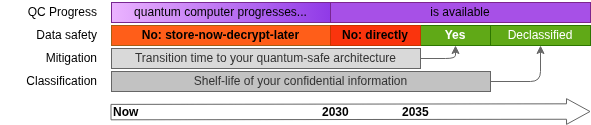
The conclusion is that even now, if you haven't started migrating to quantum-safe cryptography, you are already behind schedule.