
From classical key exchange to quantum-safe key supply
Most of today’s encrypted network traffic still relies on asymmetric cryptography for key exchange, for example mechanisms based on RSA or elliptic curves. These methods are widely deployed and secure against classical computers, but they are not designed to withstand large-scale quantum computers. Once such machines become available, they could break many of the public-key mechanisms that currently protect the setup of encrypted connections.
The transition to quantum-safe networks therefore focuses on replacing vulnerable key exchange methods, while keeping proven symmetric encryption methods such as AES for protecting the actual data payload. In a quantum-safe architecture, transport encryption continues to encrypt the traffic, but the keys used by that encryption layer are supplied by quantum-safe mechanisms.
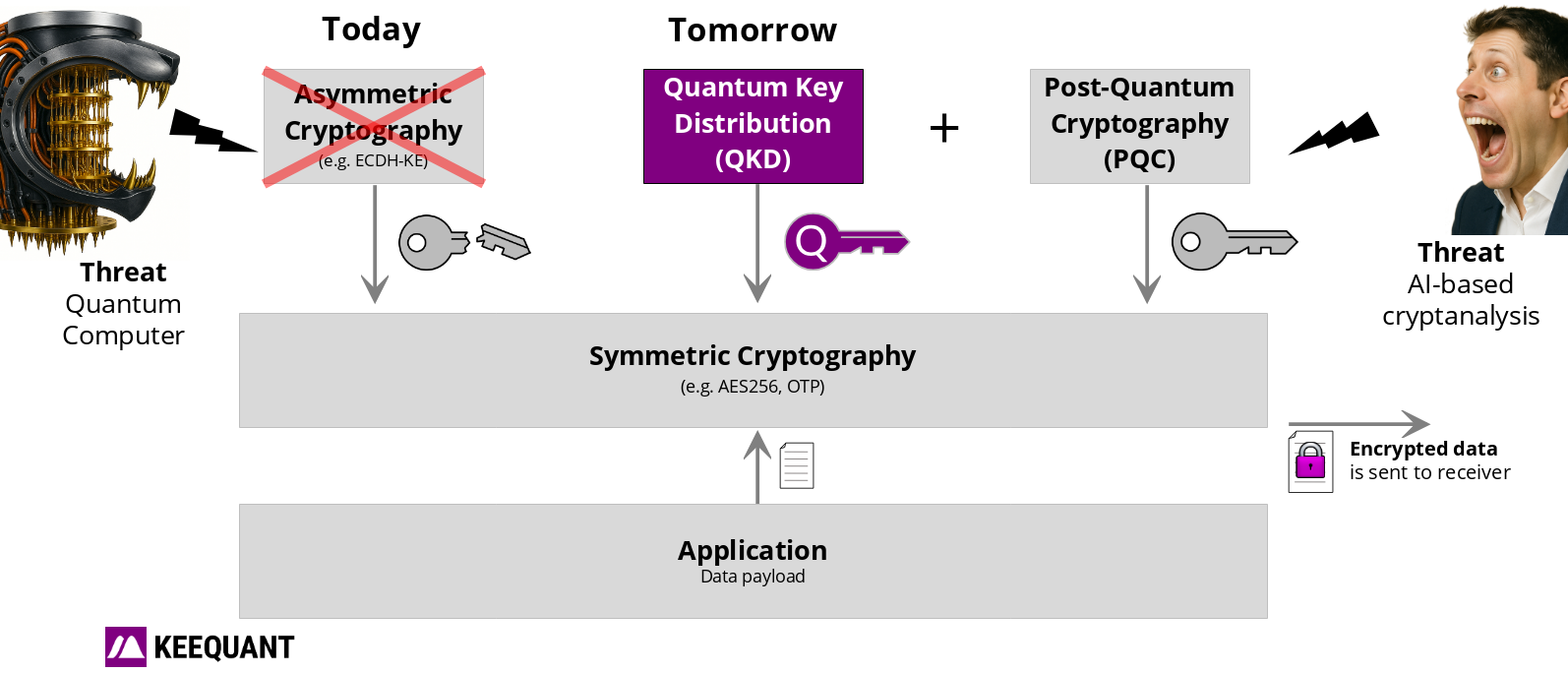
Two complementary technologies are expected to play a central role: Post-Quantum Cryptography (PQC) and Quantum Key Distribution (QKD). PQC provides software-based algorithms designed to resist quantum attacks. QKD provides cryptographic key material using quantum-physical properties of optical communication links. Together, they can form a hybrid key supply architecture in which transport encryption receives fresh, quantum-safe keys from one or more independent sources.
This separation is important: applications and data payloads do not need to “become quantum”. Instead, the network architecture evolves underneath them. Sensitive data is still handled, classified, transmitted and protected according to normal security processes, but the cryptographic foundation used to protect it becomes quantum-safe.
For practical guidance on identifying which data and network connections require stronger protection, see:
Handling sensitive data in your company network
No comments to display
No comments to display